
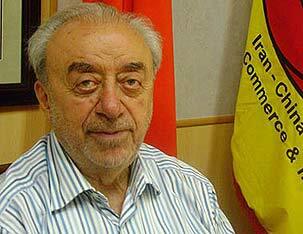
Asadallah Asgar Oladi however has a hand in politics but is not interested in political talks. This political figure who is also in business, knows Imam's attitudes and approaches well. The early years of 40 decade and the beginning of clerical uprising with the leadership of Imam Khomeini (SA) marks the acquaintance of this long-life businessman with the great founder of Islamic Republic when Imam had no way but to leaven the country and they were Hajj Habiballah and Asadallah who often paid Imam visits.
Mr. Oladi, through these visits, got Imam`s mission of handing over the letter of 'Strike-Organizer Committee' to Doctor Bahonar. Now he is here to tell us on those days when the 'Seven-Member Committee' was formed and by which the 'Chamber of Commerce' escaped of dissolution.
Mr. oladi as you are an economical figure and your brother a political one. How was the path of your acquaintance with Imam?
Habiballah, my brother, right one or two months before the Revolution, informed me of his decision to go to Paris. Those days, Imam Khomeini (SA) also was in Paris, taking control of the atmosphere inside Iran and my brother wanted to pay Imam a visit and to be at his disposal. But, since he had just been released from prison, he was barred from leaving the country. For that reason, I tried to pave the way for him to leave. The remedy for the problem was to contact Mr.Bonakdar who was in Chamber of Commerce. I told him the story on my brother's problem. Then I went to police department and signed my commitment to get permission for my brother's departure. Shortly after, we, both, went to paris to visit Imam and to be in his service. I first met Imam, there. Of course, I had already visited Imam twice in Najaf and Habiballah, my brother, knew Imam and was in his service long before the death of Ayatollah Brojerdi. By the way, Imam welcomed us warmly with open arms and gave my brother a hug while Habiballah was weeping because he has not met Imam for long since his years in prison. After the common greetings, Imam told me" you can leave Paris but Habiballah would linger here, and stay with me'. I did so because, those days, I was in business and had to travel a lot to other provinces of Iran. Finally, after leave-taking with Imam, I planned to travel back to Paris again to accompany my brother on the flight back to Tehran. But, Imam, while he was sealing an envelope, said:" Hajj Habiballah would linger here, take this envelope and deliver it to Doctor Bahonar as soon as you get to Tehran". I did as Imam had ordered. In Iran, I called Mr.Bahonar and told him about the envelope. Then we planned an appointment. Unfolding the letter, Mr.bahonar and I learned it was Imam's command on assignment of forming the "Strike-Organizer Committee". That time I had not the slightest idea what the content of the letter was. At the end, being fully unaware of the things were going on, I went back to work and my company which was closed for months to run it again.
Where did the Imam's command on the Committee end in? How did you get involved as a member?
Mr.Bahonar formed the Committee after receiving the letter. Each member was in charge of a part of the country. Then a meeting, under the supervision of Mr.Bahonar and Beheshti was held by Mr. Mir Mohammad Sadeghi and Lulachiyan to discuss the issues of Committee.
What was the task of the Committee?
We used to make facilities aimed at relieving people's problem by the support of government employees. I mean it was the task of helping people, get out of trouble and obstruction of Pahlavi's state laws and, luckily, it worked. After that committee, the idea of "Eight-Member Committee" was put forth. One day, saying the Morning Prayer in a dark winter morning, I received a call from Mr.Beheshti's house. I was meant to go to Mr. Mir Mohammad Sadeghi's office. It was dark and risky but I got dressed and set out until I was there at seven thirty. I found five or six other people there including Mr. Khamoushi. We, eight men - (Mr. Sadeghi and his brother, Mr. Ali Nasab, Mr. Navid, Mr,Khmoushi, Mr,Kord Ahmadi, Mr. Pour Shahami and Me)- were designated as Imam's Agents on his command. Of course, Mr. Sadeghi's brother declined the offer. I also said I had finished my duty and wanted to settle down my own life but they did not consent.
What was the story of the "Eight-Member Committee"?
On Bahman 27th, Doctor Beheshti received Imam`s order. An order which had these names: Me, Mir Mohammad Sadeghi, Mir Mostafa Ali Nasab, Ali hajj Tarkhani, .Pour Shahami, Mohammad Ali Navid, Engineer Alinaghi Khamoushi. After a month, Mr. Mir fendreski was added too and Mr. Pour Shahami declined to accompany us either.
At that time, we had nowhere to gather and for that reason, Mr. Khmoushi offered us to reunite in the Chamber of Commerce. Then Mr. Beheshti asked Imam for permission to do so and finally, we held our meetings on the 9th floor of Chamber of Commerce. The room, where we were handling the affairs, was carpeted just like small prayer rooms. I have it right in my mind; I first saw Iraqi planes in our country's sky in 1359 while we, along with Hajj Tarkhani and Mr. Pour Shahami, had lunch on ninth floor. Interestingly, the Chamber of Commerce has great stories behind it. The window in Chamber of Commerce overlooked the Embassy of United States where we witnessed and beheld the aftermath in the Capture of this Embassy.
And now, things the Committee did: we were looking after business men and their affairs and strove hard against all ongoing threats to keep the Chamber of Commerce up. Each member, on behalf of Imam, had visits to the countries in conflict with Iran to settle the disputes. As we were a private sector, it was a lot easier for us to contact and negotiate with the other countries' officials for example England whose Embassy in Iran was closed and therefore we, along with Mr. Alinaghi, in a visit to England, negotiated with members of their House of Lords and London Chamber of Commerce and these negotiations resulted in the opening of their Consulate in Iran. Once we traveled to Germany to remedy some economical problems while a German citizen in Iran was in prison for moral charges. As I remember, before the departure to Germany, I met the then Head of Judicial Branch (which was not established yet, that time) and told him" we are going to have a visit to Germany, not for personal affairs, but to settle the problems there. German state has blocked our bank accounts and we want to reopen them". And so I demanded the freedom of the German citizen as a bonus in our negotiations with German officials. Luckily, this bonus facilitated the process of settling the problems in a meeting with German Chancellor. Honestly, Engineer Khamoushi did his best in this visit. In a nutshell, we tried hard to settle down the affairs these over eight years and afterward the Board of Directors in Chamber of Commerce was formed and Mr. Khamoushi was appointed as the head Director of this Chamber.
Please tell us about the time, the Committee was active. How had Imam been informed of the Committee's function?
I used to go to Qhom to report Imam on the Committee and its functions. As you know, our borders, due to the gravity of situation inside the country in the early years of Revolution, were closed and no one was able to leave the country. We were in the Chamber of Commerce where we met a multitude of traders, complaining of the ongoing critical situation and that they were facing obstacles in their business. Consequently, we reported Imam on the matter and Imam asked Martyr Rajayee to hold a Committee for dealing with the hardships of those who were to leave the country. Therefore, I and two other people were supposed to investigate the permit of applicants of leaving the country. Luckily, by the Government's consent, most of these traders got that permit and after months, as I have it clearly in my mind, their spouses complained why they couldn't have permit to accompany their husbands leaving the country. That time, Mr. Rajayee was martyred and I had to consult Imam about the matter and Imam consented to the permit of traders' spouses to accompany them in going abroad.
Tell us what happened to the private sector. Mr. Tarkhani was one of those whose properties were confiscated. What was Imam's stance on this issue?
Mr. tarkhani was a highly respected religious merchant and known to everybody. He was very annoyed of this matter and even didn't consent and let Mr.Beheshti cross off his name from the list of those whose property was confiscated. I think it was because of his familiarity with Mr.Bazargan and so he was worry about its consequences that could tarnish Bazargan's reputation. Briefly, he stayed with us despite all the hardships. Meanwhile, Imam, on (Esfand15, 1357) ordered me, Mr.tarkhani and Hajj Habiballah Shafigh to deal with properties of HajirYazdani and the decree is available in Imam's Sahife, vol 6, p.322.
Hajir Yazdani had a close contact with the Pahlavi regime and possessed a good fortune and property for example more than two thousand sheep in the suburbs of Semnan province. Once, these sheep were taken around the Chamber and we were asked to take their number into account. Shortly after, we, along with Mr. Tarkhani, made a thorough list of all his properties including mines, factories, banks, gas stations. To do so, we underwent some hardships, and so, we and Mr.Tarkhani went to Imam and turned in the list. Imam asked us to consult Hajj Ahmad about it and to give all the properties to the Bonyad Foundation. Afterward, we talked to Hajj Ahamd about that and finally all those properties were handed over to the 'Mostazaffin Bonyad' (Foundation for the Oppressed). The head of the Foundation was Mir Hossein Mosavi.
And now tell us about the happenings in the discussion of confiscations. It seems that the list of confiscations was confirmed by the 'Council of Revolution' when Mr.Rafsanjani was in bed due to the injury and Mr.Beheshti was not attended in the session.
No, the discussion of confiscations was brought forward from the very early two or three months of the Revolution and had nothing to do with Mr.Rafsanjani's ailment and absence of Mr.Beheshti. Actually, we tried to settle down the situation with Imams support. And great measures were taken and done but the issue of confiscations was something different and had not anything to do with us.
Aside from this case, as you mentioned before, you had a close relationship with Imam. How do you evaluate Imam's approach and attitude towards unions and private sector?
I, myself, was a small businessman and the members of Chamber have been invited too when authorities were to visit Imam. The Chamber was comprised of businessmen and great union-keepers. Imam always had these people by his side and backed those who earned living through legitimate ways. Formation of 'Eight-Member Committee', with these traders at its center, was an indicator of Imam's attention to the Unions.
In his opinion, Legitimacy was the border in possessing wealth and legitimate wealth was not unlawful. I